Pragmatic Language

How Children Use Language in Social Communication

Definition

What Is Pragmatic Language?

Pragmatic language refers to how children use communication in social situations. It includes the way a child uses words, gestures, facial expressions, body language, tone of voice, and shared understanding to interact with other people.

Pragmatic language is not just “being social” or “talking a lot.” A child may use many words but still have difficulty staying on topic, giving enough information, understanding another person’s perspective, reading social cues, or knowing how to adjust language for different people and settings.

A child uses pragmatic language when they

greet others
ask for help
make comments
take turns in conversation
stay on topic
change how they speak depending on the listener
understand facial expressions, tone, and body language
repair a message when someone does not understand
understand jokes, sarcasm, idioms, and indirect meaning
tell stories in a way that makes sense to the listener
explain feelings, opinions, or social problems

Pragmatic language is one part of social communication. Social communication also includes social interaction, social understanding, language processing, and the ability to use communication successfully across different situations.

Pragmatic language may be different across cultures, families, communities, and communication styles. There is no "one size fits all" in communication, the goal is to help children communicate, participate, and understand others in the environments that matter to them.

Pragmatic vs Expressive and Receptive Language

How Is Pragmatic Language Different from Expressive and Receptive Language?

What is the difference between pragmatic language, receptive language and expressive language?

Receptive language is how a child understands language. Expressive language is how a child uses words, sentences, and grammar to communicate. Pragmatic language is how a child uses communication socially and flexibly with other people.

A child may have strong vocabulary and grammar but still have pragmatic language difficulty. For example, they may know many words but have trouble taking turns, noticing when someone is confused, understanding sarcasm, staying on topic, or adjusting language for a teacher versus a friend.

A child may also have broader language needs that affect receptive, expressive, and pragmatic language together. This is why assessment should look at the child’s full communication profile.

Pragmatic language is how a child uses language socially and appropriately for the context. It refers language use.
Expressive language is how a child uses language to communicate thoughts, needs, and ideas. It is output side of communication.
Receptive language is how a child understands language. It is the input side of communication.

Pragmatic language overlaps with receptive and expressive language, but it also includes social reasoning, context, flexibility, and nonverbal communication. A child may understand words and produce sentences but still need support communicating effectively with peers, adults, and groups.

Pragmatic language skills

What Skills Are Part of Pragmatic Language?

Pragmatic language is a set of social communication abilities that help children interact, participate, collaborate, repair communication breakdowns, understand non-literal language and non-verbal cues.

Communication Functions

Using Language for Different ReasonsChildren use pragmatic language for many purposes. They communicate to request, protest, greet, comment, ask questions, share interests, explain ideas, tell stories, clarify confusion, and express feelings.

Communication Function
Examples
Requesting
“Can I have the blocks?”
Commenting
“That tower is really tall.”
Greeting
“Hi, Ms. Lee.”
Protesting
“I don’t want that one.”
Asking for help
“Can you show me?”
Explaining
“I picked this because it matches.”
Repairing
“I mean the blue one, not the green one.”
Sharing interest
“Look what I made!”

A child with pragmatic language difficulty may use language for a limited range of purposes. For example, they may request what they want but rarely comment, ask about others, share interests, or understand sarcasm.

Conversation Skills

Conversation requires more than answering questions. Children need to notice when it is their turn, respond to what someone said, add related information, ask follow-up questions, and shift topics in a way the listener can follow.

Pragmatic language difficulty may look like interrupting often, giving very short responses, talking mainly about preferred topics, changing topics suddenly, or not noticing when the listener is confused or losing interest.

starting a conversation
responding to a partner
taking turns
asking related questions
making relevant comments
staying on topic
shifting topics smoothly
ending a conversation appropriately

Listener Awareness

Children learn to adjust how they communicate depending on who they are talking to and where they are. They may speak differently to a baby sibling, a friend, a teacher, a principal, or a new adult.

giving enough background information
noticing what the listener already knows
using more detail when needed
changing tone or word choice based on the setting
explaining effectively when the listener looks confused
using formal language when appropriate

Listener awareness includes knowing what the other person already knows, how much detail they need, and what kind of language fits the situation.

Nonverbal Communication

Pragmatic language includes nonverbal communication such as facial expressions, gestures, body position, personal space, eye gaze, tone of voice, and emotional expression.

Nonverbal communication should be interpreted carefully. Eye contact, gesture use, body language, personal space, and conversational style vary across cultures, families, neurotypes, and individual communication preferences.

Nonverbal Cues
Examples
Facial expression
Noticing happy, confused, surprised, bored, or upset expressions
Gesture
Pointing, waving, shrugging, nodding
Tone of voice
Recognizing joking, serious, frustrated, excited, or unsure tone
Body language
Noticing when someone turns away, leans in, or signals discomfort
Proximity
Understanding personal space expectations in different settings
Shared attention
Looking at or referencing the same object, event, or idea with another person

Perspective-Taking

Perspective-taking is the ability to understand what another person may know, think, feel, want, or believe. It helps children interpret social situations, solve problems, participate in group work, and explain ideas in a way another person can understand.

identifying feelings
noticing what another person knows or does not know
understanding why someone acted a certain way
explaining another person’s perspective
predicting how someone may respond
solving social problems with others in mind

A child with perspective-taking difficulty may have trouble recognizing why someone is upset, understanding that another person has different information, or explaining a situation from someone else’s point of view.

Inferencing and Implied Meaning

Pragmatic language also includes understanding meaning that is implied rather than directly stated. Children use pragmatic skills to understand jokes, sarcasm, figurative language, indirect requests, and social hints.

indirect requests
sarcasm
humor
idioms
figurative language
implied emotions

For example, if a teacher says, “It’s getting noisy in here,” the literal meaning is about the noise level, but the implied meaning may be that students should lower their voices.

Pragmatic language milestones

Pragmatic Language Milestones by Age

Children develop pragmatic language gradually. Early social communication begins before children use many words. It starts with shared attention, smiling, gestures, vocal turn-taking, showing objects, pointing, and responding to familiar people.

As children grow, pragmatic language becomes more complex. Children begin to use language in conversation, storytelling, peer interaction, group work, humor, perspective-taking, or sarcasm.

Age Range
Pragmatic Language Skills Children May Show
Birth–12 months
Smiles, responds to familiar voices, takes turns making sounds, looks toward people, shares attention, uses early gestures, and begins responding to social routines
12–18 months
Points, shows objects, waves, uses gestures or sounds to get attention, participates in simple games, and begins using early words for social purposes
18–24 months
Uses words or gestures to request, protest, greet, comment, and share interest; begins simple pretend play; may take short turns in familiar routines
2–3 years
Uses words for different purposes, takes brief conversational turns, asks or answers simple questions, joins simple play, and begins using language to share feelings or ideas
3–4 years
Participates in longer back-and-forth exchanges, uses pretend play, asks questions, repairs simple misunderstandings, and begins adjusting language for familiar listeners
4–5 years
Keeps conversation going for multiple turns, tells simple stories, understands basic emotions, follows group routines, joins peer play, and begins understanding indirect meaning in familiar situations
Kindergarten–2nd grade
Stays on topic more consistently, retells events, participates in classroom discussion, asks for help or clarification, begins understanding jokes and simple figurative language
3rd–5th grade
Uses more organized narratives, considers another person’s perspective, explains social problems, understands humor, and participates in group activities with peers
6th grade +
Uses language across different settings, understands sarcasm and nuanced social meaning, participates in discussions, manages peer relationships, self-advocates, and adapts communication for school, community, and eventually workplace contexts

For older students, pragmatic language is less about early social routines and more about flexible communication. Students need to understand implied meaning, participate in group discussions, repair misunderstandings, interpret social nuance, manage peer relationships, and adjust language across classrooms, friendships, online communication, jobs, and community settings.

Pragmatic language difficulties

Signs of Pragmatic Language Difficulty

Pragmatic language may be different depending on a child’s age, development, culture, language background, personality, neurotype, and communication environment.

Signs in Toddlers

A toddler may show pragmatic language concerns if they:

rarely point or show objects to share interest
have limited back-and-forth social interaction
do not consistently respond to familiar social routines
have difficulty joining simple play
use few gestures to communicate
rely mostly on pulling adults toward what they want
have limited social smiling or shared enjoyment
rarely imitate sounds, actions, or simple social routines
have difficulty using words or gestures for different purposes

Signs in Preschool Children

A preschool child may show expressive language difficulties if they:

have trouble joining play with other children
have difficulty taking turns
talk mostly about preferred topics
give answers that do not match the question
have trouble repairing misunderstandings
do not notice when someone is confused
struggle to ask for help or clarification
misunderstand basic social cues, facial expressions, or tone

Signs in School-Age Children

A school-age child may show pragmatic language delays if they:

have difficulty staying on topic
interrupt often or have trouble waiting for a turn
give too little or too much information
struggle with classroom discussion
have difficulty working with partners or groups
misunderstand jokes, idioms, or sarcasm
answer questions in a way that seems off-topic
miss implied meaning in books or conversation
have difficulty recognizing another person’s perspective
struggle to repair communication breakdowns

Signs in Older Students

Older students may show pragmatic language concerns in more subtle ways. They may have difficulty:

understanding sarcasm or indirect language
interpreting tone, mood, or emotional nuance
explaining their perspective calmly and clearly
adapting language for teachers, peers, employers, or unfamiliar adults
participating in group projects
understanding social expectations across settings
recognizing when a listener needs more information
understanding figurative language or implied meaning in reading
adapting communication style in community or workplace

A child with pragmatic language challenges may have difficulty using communication in ways that fit the situation. They may struggle to join play, take turns, stay on topic, notice social cues, repair misunderstandings, understand implied meaning, or explain their thoughts in a way others can follow. Pragmatic language difficulty may be mistaken for rudeness, immaturity, inattention, shyness, behavior, or lack of interest.

Delay vs. Disorder

Pragmatic Language Delay or Disorder

A pragmatic language delay generally means a child’s social communication skills are developing slower than expected for their age or setting. It is often used informally, especially when describing younger children.

A pragmatic language disorder, or more formally a social communication disorder, means the child has persistent difficulty using verbal and nonverbal communication socially in ways that affect participation, learning, relationships, or daily functioning.

Some young children with early social communication delays make progress with support and development. However, persistent pragmatic language difficulties may become more concerning as social and academic demands increase, especially when they affect peer interaction, classroom discussion, storytelling, inferencing, group work, self-advocacy, or independence.

Pragmatic language difficulties may occur on their own or along with:

receptive language difficulties
expressive language difficulties
developmental language disorder
speech sound disorders
autism
ADHD
developmental delays
learning disabilities
traumatic brain injury

Pragmatic language difficulty does not mean autism. Some children with autism have pragmatic language needs, but social communication disorder and autism are not the same. A comprehensive evaluation helps determine whether a child’s profile reflects a delay, a disorder, autism, DLD, ADHD, hearing-related needs, or another developmental factor.

Examples

Examples of Pragmatic Language in Everyday Life

Pragmatic language is used throughout the day. It affects how children interact during routines, play, conversation, schoolwork, reading, group activities, friendships, and problem-solving.

At Home

A child uses pragmatic language at home when they:

say “look!” to share something interesting
ask for help instead of becoming frustrated
change how they speak to a younger sibling
tell a parent what happened
explain why they are upset
take turns during a family game
use tone, facial expression, or gestures appropriately to support their message

At School

A child uses pragmatic language at school when they:

raise their hand or wait for a turn
answer a question in a way that fits the topic
ask for clarification
work with a partner
follow discussion rules
notice when the teacher needs more information
adjust language for the classroom setting

In Conversation

A child uses pragmatic language in conversation when they:

start a conversation
respond to what someone else said
ask a related question
make a relevant comment
stay on topic
transition and shift topics
repair a misunderstanding
use humor or understand when someone else is joking

During Reading Learning

A child uses pragmatic language during reading and learning when they:

explain what a character might be thinking
understand why a character acted a certain way
identify implied meaning
understand humor, sarcasm, or figurative language
answer inferential questions
discuss different viewpoints
School and daily life

How Pragmatic Language Difficulties Can Affect School

Pragmatic language difficulties can affect much more than conversation.

When a child has difficulty using social communication, the impact can show up across the school day. They may struggle with class discussions, partner work, group projects, peer interaction, storytelling, inferential reading questions, conflict resolution, or asking for help.

Some children become quiet or withdrawn. Others may appear silly, controlling, impulsive, avoidant, argumentative, or off-topic. In some cases, behavior may reflect difficulty interpreting social cues, understanding expectations, repairing communication, or expressing needs clearly.

Pragmatic language difficulties can affect:

peer relationships
classroom participation
social interaction
peer interaction
conversation
storytelling
group work
inferencing
understanding emotions
understanding humor
Speech Therapy

How Speech Therapy Helps Pragmatic Language

Speech-language pathologists evaluate and treat pragmatic language and social communication difficulties. Therapy is individualized based on the child’s age, communication profile, language skills, cultural and linguistic background, learning environment, social needs, and functional goals.

Speech therapy for pragmatic language focuses on helping children understand communication expectations, express themselves in different social contexts, participate with others, repair misunderstandings, and use strategies that support real-life communication.

A speech-language pathologist may work on:

initiating conversation
greeting others
requesting help
asking and answering social questions
taking turns
staying on topic
making relevant comments
adding enough information
repairing misunderstandings
understanding facial expressions and tone
interpreting indirect language
understanding jokes, idioms, and sarcasm
perspective-taking
participating in group discussion

For younger children, therapy may focus on play-based interaction, shared attention, social routines, pretend play, turn-taking, requesting, commenting, and caregiver coaching. For school-age children and older students, therapy may focus on conversation, peer interaction, classroom participation, perspective-taking, inferencing, narrative language, social problem-solving, social communication, and self-advocacy.

Assessment

Pragmatic Language Assessment

A pragmatic language evaluation may include formal and informal tools. Screening can help identify whether concerns are present, but screening alone does not diagnose a pragmatic language or social communication disorder.

A comprehensive assessment may include:

parent or caregiver concerns
teacher input
developmental and medical history
hearing screening results
observation during play, conversation, or classroom tasks
standardized language testing when appropriate
pragmatic language checklists or rating scales
informal conversation samples
structured social communication tasks
narrative language tasks
classroom or curriculum-based language samples
Goals

Pragmatic Language Goals for Speech Therapy and IEPs

Pragmatic language goals should be specific, measurable, functional, and connected to the child’s real communication needs. Goals should support participation across meaningful settings, such as play, conversation, classroom discussion, group work, peer interaction, storytelling, self-advocacy, and problem-solving.

SMART pragmatic language goal should describe:

time reference
specific skill being targeted
context or activity
level of support
measurable outcome
how progress is measured
Pragmatic Language Area
SMART Goal Example
Conversation Initiation Goal
By the next IEP, during structured peer or adult interaction, the student will initiate a conversation using an appropriate greeting, comment, or question in 4 out of 5 opportunities, given visual or verbal support as needed, across three consecutive sessions, as measured by SLP data collection.
Turn-Taking Goal
By the next IEP, during a structured game or conversation activity, the student will take at least three reciprocal turns with a communication partner in 4 out of 5 opportunities, given minimal verbal prompts, as measured by SLP data collection.
Topic Maintenance Goal
By the next IEP, during a structured conversation, the student will make a relevant comment or ask a related question to maintain the topic of discussion for at least three conversational turns in 4 out of 5 trials, given minimal support, as measured by SLP data collection.
Conversational Repair Goal
By the next IEP, when a communication breakdown occurs, the student will use a repair strategy, such as repeating, rephrasing, adding detail, or asking for clarification, in 4 out of 5 opportunities, given minimal verbal prompts, as measured by SLP data collection.
Perspective-Taking Goal
By the next IEP, given a social scenario, the student will accurately identify another person’s thought, feeling, or perspective and explain one reason behind it, in 4 out of 5 trials, given minimal verbal support, as measured by SLP data collection.
Inferencing Goal
By the next IEP, after listening to or reading a short passage, the student will explain implied meaning or character intent using at least one relevant clue from the text with 80% accuracy, given minimal prompts, as measured by SLP data collection.
Nonliteral Language Goal
By the next IEP, given grade-level idioms, jokes, sarcasm, or figurative expressions, the student will explain the intended meaning with 80% accuracy, given minimal cues, as measured by SLP data collection.
Activities

Pragmatic Language Activities for Children

Pragmatic language activities should be developmentally appropriate, functional, respectful of the child’s communication style, and connected to real situations. The best activities help children practice social communication during play, books, routines, conversation, classroom tasks, group work, and everyday problem-solving.

Pragmatic Language Activities for Toddlers

Try activities such as:

peekaboo and turn-taking games
pointing and showing during play
rolling a ball back and forth
waving hello and goodbye
copying simple actions
using words or gestures to request help
labeling feelings during routines
sharing attention with books, toys, or songs

For example: During play, pause and wait for the child to gesture, look, vocalize, or use a word to continue the routine. Then respond warmly and model a simple phrase such as “more bubbles,” “my turn,” or “look, car!”

Pragmatic Language Activities for Preschoolers

Try activities such as:

pretend play routines
turn-taking games
role-play with dolls, animals, or puppets
picture books with emotion talk
simple conversation practice
social problem-solving with pictures
asking and answering “who,” “what,” and “where” questions
practicing how to ask for help

For example: During pretend play, model short social phrases such as “Can I play?” “Your turn,” “I need help,” or “Let’s make food.” Then help the child use those phrases in a natural play routine.

Pragmatic Language Activities for School-Age Children

Try activities such as:

conversation maps
topic maintenance games
social scenario cards
perspective-taking stories
role-play for asking for help
group-work scripts
idiom and joke discussion
identifying clues to make inferences

For example: After reading a short story, ask, “What does the character know?” “What does the other character know?” and “How do we know?” This helps the student connect language, perspective-taking, and evidence.

Pragmatic Language Activities for Older Students

Try activities such as:

analyzing sarcasm, humor, and indirect language
preparing for group discussions
planning role-playing conflict resolution
comparing communication across settings
planning what to say to a teacher, peer, or employer
identifying implied meaning in articles, videos, or literature

For example: Before a group project, help the student prepare phrases such as “What part should I do?” “Can we make a plan?” “I disagree because…” or “Can you explain what you mean?” This supports participation without requiring the student to guess the language in the moment.

Data Collection

Data Collection for Communication and Language Goals

SLPs often need to document not only whether a student performed a skill, but how much support was needed, how consistently the skill occurred, and whether the skill generalized across people, materials, or settings.

Accuracy and trials
Prompt level and cueing type
Level of independence
Frequency, duration, and rubric scores
Spontaneous use and generalization
See Data Collection Tools
Documentation

Documentation Examples for SLPs

Accurate documentation helps SLPs summarize what was targeted, how the student performed, what supports were needed, and how therapy connects to functional communication.

SOAP notes and session notes
Caregiver updates
IEP goal documentation
Evaluation summaries
Progress reports and present levels
Workflow

From Goal Writing to Progress Reports

Receptive language therapy is not one isolated session, it requires strcutured and individualized approach. iSpeax is designed to support  complete workflow from goal setting to intervention, data, collection, documentation management, finance, scheduling and more.

1
Choose communication skill
2
Write measurable goals
3
Plan therapy activities
4
Collect session data
5
Document progress
6
Generate reports
FAQ

Frequently Asked Questions

What is pragmatic language?

Pragmatic language is how a child uses communication socially. It includes conversation, turn-taking, topic maintenance, social cues, perspective-taking, storytelling, inferencing, repairing misunderstandings, and adjusting language for different people and settings.

What are pragmatic language skills?

Pragmatic language skills include greeting, requesting, commenting, asking questions, taking turns, staying on topic, giving enough information, using and understanding nonverbal cues, repairing communication breakdowns, understanding implied meaning, and considering another person’s perspective.

How is pragmatic language different from expressive and receptive language?

Receptive language is what a child understands. Expressive language is what a child says or otherwise communicates. Pragmatic language is how the child uses communication socially and flexibly in context.

Is pragmatic language the same as social communication?

Pragmatic language is part of social communication. Social communication is broader and includes pragmatics, social interaction, social understanding, language processing, and the ability to communicate effectively across people and settings.

Is pragmatic language difficulty always autism?

No. Pragmatic language difficulty does not automatically mean autism. Pragmatic weaknesses may occur with autism, developmental language disorder, ADHD, hearing differences, learning disabilities, traumatic brain injury, or other developmental profiles. A comprehensive evaluation helps clarify the child’s needs.

What is social communication disorder?

Social communication disorder is a clinical diagnosis involving persistent difficulty using verbal and nonverbal communication socially. It may affect conversation, relationships, classroom participation, understanding implied meaning, and adapting communication across settings. It requires comprehensive evaluation and differential diagnosis.

What are signs of pragmatic language difficulty?

Signs may include difficulty taking turns, staying on topic, joining play, making relevant comments, understanding jokes or sarcasm, repairing misunderstandings, reading social cues, explaining ideas clearly, participating in group work, or understanding another person’s perspective.

How do SLPs assess pragmatic language?

SLPs assess pragmatic language using multiple sources of information, such as caregiver and teacher input, observation, conversation samples, structured tasks, classroom or peer interaction, rating scales, narrative tasks, and functional communication data. One test score alone is not enough to diagnose pragmatic language difficulty.

Can pragmatic language improve with speech therapy?

Yes. Pragmatic language skills can improve with individualized, functional, and context-based intervention. Therapy may include modeling, role-play, peer practice, social scripts, video modeling, conversation practice, perspective-taking activities, classroom supports, and caregiver or teacher collaboration.

When should a child be evaluated for pragmatic language concerns?

A child may benefit from evaluation when pragmatic language concerns are persistent, affect participation, interfere with friendships or school, cause frequent misunderstandings, or make it difficult for the child to communicate needs, ideas, feelings, or social intent across settings.

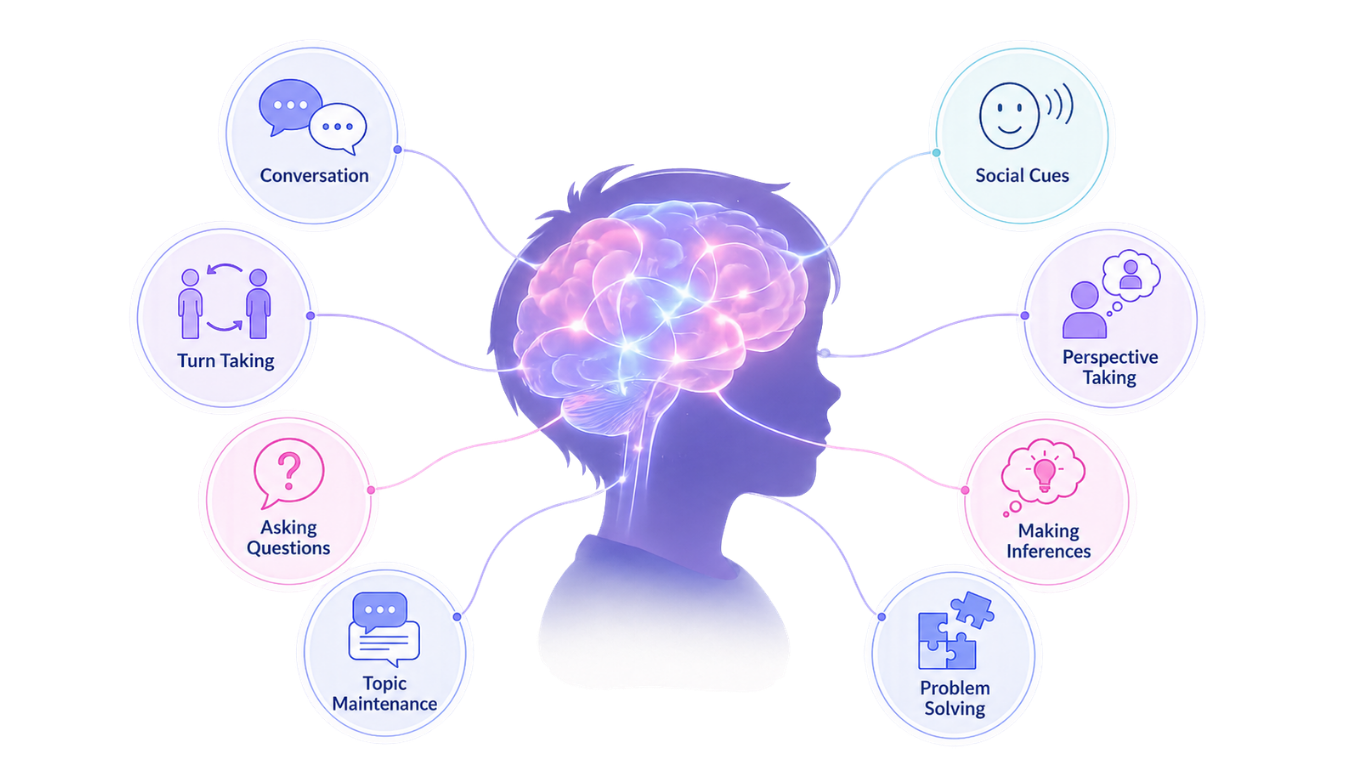
Build Pragmatic Language Support with iSpeax

iSpeax helps speech-language pathologists, educators, and therapy teams organize pragmatic language support, track session data, and manage documentation in one connected workflow.

From conversation and turn-taking to topic maintenance, perspective-taking, social inferencing, group discussion, communication repair, and self-advocacy, iSpeax helps providers connect intervention planning to measurable progress and streamlined documentation.

Whether you are supporting social communication, peer interaction, classroom participation, or real-life communication skills, iSpeax helps turn therapy data into organized notes, progress updates, and compliant reports.