Expressive Language

How Children Use Language to Communicate

Definition

What Is Expressive Language?

Expressive language refers to a child’s ability to communicate meaning. It is how a child uses language to share thoughts, needs, feelings, ideas, and information with other people.

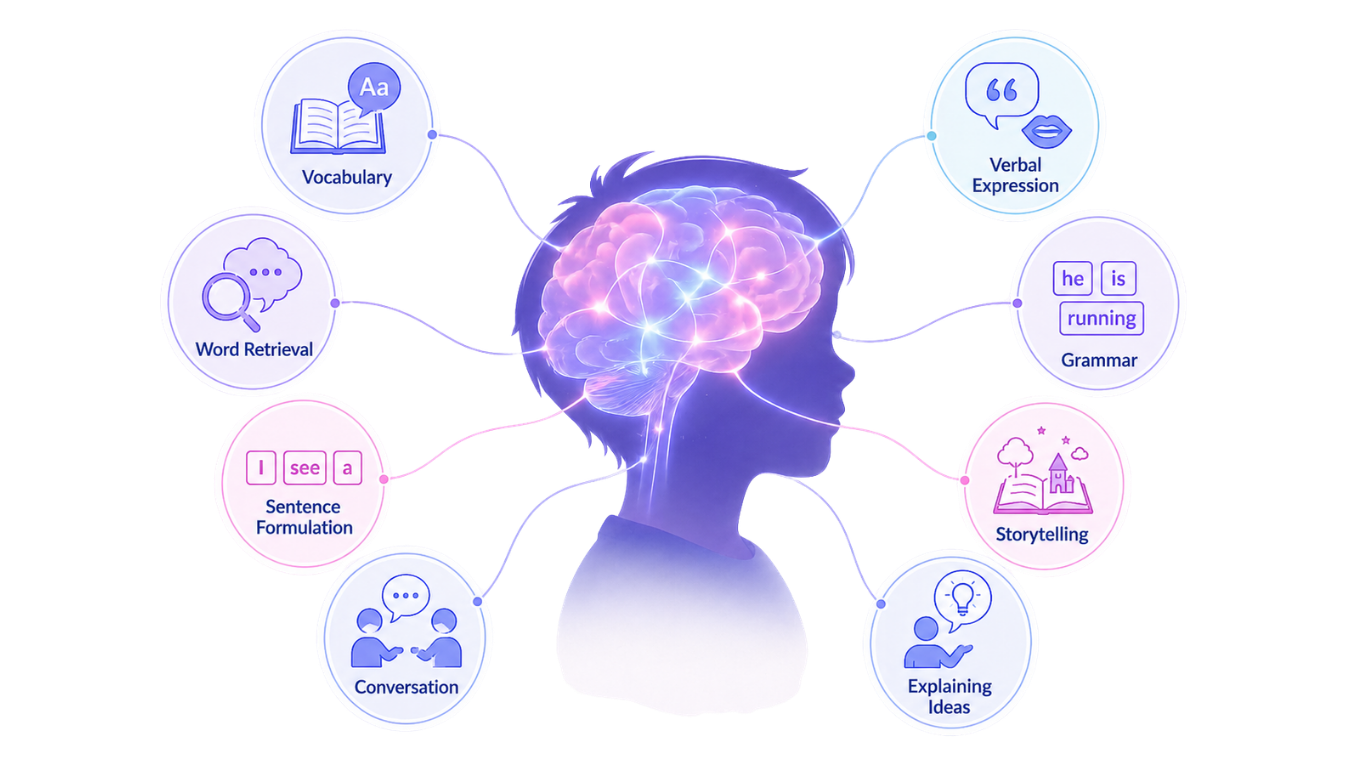
Expressive language includes using words, combining words into phrases and sentences, using grammar, answering questions, telling stories, explaining ideas, participating in conversation, and adjusting language for different listeners and situations.

In early childhood, expressive language begins with sounds, gestures, babbling, pointing, using signs, and first words. As children grow, expressive language expands into longer sentences, storytelling, classroom discussions, writing, academic vocabulary, and self-advocacy.

A child uses expressive language when they:

say first words such as “mama,” “ball,” or “more”
combine words, such as “more milk” or “go outside”
name objects, actions, people, or places
answer questions using words, phrases, or sentences
tell what happened during the day
retell a story or describe an event
explain an idea, opinion, problem, or feeling
participate in conversation with others

Expressive language can be spoken, written, or communicated through another system of symbols or signs. Speech refers to how sounds are produced, while expressive language refers to how a child forms and communicates language meaning.

Expressive vs Receptive Language

What Is the Difference Between Expressive and Receptive Language?

Expressive and receptive language are related, but they are not the same.

Expressive language is how a child uses language to communicate thoughts, needs, ideas, and feelings. It is output side of communication.
Receptive language is how a child understands language. It is the input side of communication.
SKILL AREA
EXPRESSIVE LANGUAGE
RECEPTIVE LANGUAGE
Main function
Understanding language
Using language
Direction
Verbal Output
Auditory Input
Examples
Naming, requesting, speaking in sentences, telling stories
Following directions, answering questions, understanding vocabulary
Classroom example
Explaining why the animal is under the table
Understanding “circle the animal under the table”
Conversation example
Answering the question
Understanding a question

Some children understand more than they can express. Other children may use many words but have trouble organizing sentences, using grammar, telling stories, or explaining ideas. This is why both receptive and expressive language should be considered when looking at a child’s complete communication profile.

Expressive language skills

What Skills Are Part of Expressive Language?

Expressive language is not one single skill. It is a combination of language abilities that help children communicate their needs, thoughts and ideas across home, school, and daily interactions.

Vocabulary

Vocabulary refers to what words the child understands and uses. Expressive vocabulary refers to the words a child can use to name, request, describe, explain, ask questions, and share ideas.

Vocabulary Skills
Examples
Naming
dog, cup, shoes, pencil
Action words
run, jump, eat, sleep, build
Describing words
big, tiny, loud, soft, beautiful
Location words
in, on, under, behind, in front of
Academic, Tier 2 Words
compare, predict, describe, explain, evaluate

A child with expressive vocabulary difficulty may use vague words such as “thing,” “stuff,” or “that one” instead of specific nouns, verbs, or describing words.

Word Retrieval

Word retrieval is the ability to access the word a child wants to say. A child may know a word but have difficulty finding it quickly during conversation, classroom discussion, storytelling, or writing.

Word retrieval difficulty may sound like frequent pauses, fillers, substitutions, or comments such as “I know it but I forgot the word.” For example:

long pauses before answering
using vague words such as “thing” or “stuff”
describing the word instead of naming it
using a related but incorrect word
saying “I forgot” or “I don’t know” even when they may know the answer

Forming Sentences

Formulating sentences is the ability to combine words into sentences while using appropriate syntax, morphology and grammar. Children need to have the skill of forming sentences to answer questions, describe pictures, retell events, explain ideas, and participate in classroom discussions. The following are important in formulating sentences:

word order
sentence length
complete thoughts
grammar
verb tense
pronouns
conjunctions

In early childhood, the child may say “dog running” before they are able to say, “The dog is running in the park.” As children grow, sentences become longer, more detailed, and more organized.

Narratives and Stories

Narrative language is the ability to tell or retell a story or event in an organized way. It includes characters, setting, problem, actions, feelings, sequence, and ending.

Narrative language supports conversation, reading comprehension, writing, classroom discussion, and social language. Narrative elements include:

who the story is about
where and when it happened
what happened first, next, and last
what the problem was
how the character felt
how the problem was solved

Grammar and Morphology

Grammar is the structure and a set of language rules that help children express their ideas accurately. Language grammar includes verb tenses, pronouns, prepositions, plurals, articles, helping verbs, or conjunctions. Some examples of grammar include:

Grammar Area
Examples
Verb tense
Regular verbs such as “she walked” instead of “she walk”; or, irregular verbs such as "he built" instead of "he builded"
Pronouns
he, she, they, I, me, we
Plurals
dogs, toys, books
Helping verbs
is running, has eaten, will go
Conjunctions
and, because, but, so
Expressive language milestones

Expressive Language Milestones by Age

Children develop at a different pace, and milestones are general guidelines, they do not follow a strict order. Milestones can help parents, caregivers, educators, and professionals keep an eye on the child's development and assist in guiding on when a child might need additional support.

Age Range
Expressive Language Skills Children May Show
Birth–12 months
Makes sounds other than crying, coos, takes turns making sounds, squeals, babbles repeated sounds such as “mamama” or “bababa,” uses gestures, and may begin using names such as “mama” or “dada”
12–18 months
Uses gestures and early words, tries to say familiar words, uses sounds or words to get attention, and begins communicating wants and needs more intentionally
18–24 months
Says several words, begins combining two words, uses words to request, label, protest, greet, or comment, and may use early action words
2–3 years
Uses about 50 or more words, combines words into three-word utterances, names familiar pictures or objects, uses early pronouns, asks simple questions, and participates in short conversational turns
3–4 years
Uses longer sentences, asks and answers WH questions, names actions, talks about daily events, and is understood by familiar listeners most of the time
4–5 years
Uses sentences of four or more words, tells simple stories, answers questions about books or events, keeps conversation going for multiple turns, and begins using more complex grammar
Kindergarten–2nd grade
Retells events, uses complete sentences, asks and answers WH questions, gives simple directions, explains ideas, and uses school-related vocabulary
3rd–5th grade
Summarizes stories, explains what was learned, uses curriculum vocabulary, paraphrases information, organizes spoken reports, and gives short presentations
6th grade +
Uses more complex academic language, participates in discussions, explains opinions with support, summarizes information, uses discipline-specific vocabulary, and practices self-advocacy

In early childhood, expressive language begins before the child starts developing their first words, it includes sounds, gestures, babbling, vocal play with sounds, and early social communication. As children grow, expressive language becomes more complex and includes sentences, stories, explanations, classroom discussion, and academic language.

Receptive language difficulties

Signs of Expressive Language Difficulty

Expressive language difficulties can look different depending on a child’s age, language background, communication environment, and developmental profile. A child with expressive language challenges may know what they want to say but have difficulty finding the words, forming sentences, using grammar, or organizing their ideas. Expressive language difficulty may be mistaken for shyness, inattention, difficult behavior, lack of effort, or refusal to participate.

Signs in Toddlers

A toddler may show expressive language concerns if they:

use very few spoken words
do not combine words by around age 2
rely mostly on gestures instead of words, such as pointing or pulling
have limited variety of words or communication functions
show slow vocabulary growth
become frustrated when they cannot express wants or needs

Signs in Preschool Children

A preschool child may show expressive language difficulties if they:

use shorter sentences than expected
have trouble answering simple questions
have difficulty asking questions
make grammar errors that are not expected for their age
struggle to describe pictures, actions, or events
have difficulty telling what happened during the day
use vague words such as “thing” or “that”
have trouble retelling simple stories

Signs in School-Age Children

A school-age child may show expressive language delays if they:

have difficulty explaining ideas
give very short or incomplete answers
struggle to retell stories or classroom events in order
have trouble using grade-level vocabulary
use disorganized sentences or explanations
have word-finding difficulty
avoid participating in class discussions
struggle with presenting
have difficulty putting thoughts into writing

Signs in Older Students

Older students may show expressive language concerns in more subtle ways. They may struggle with:

summarizing information
explaining opinions with sufficient reasoning
using academic vocabulary
using complex sentences
retelling information from reading or lectures
participating in group discussions
Delay vs. Disorder

Expressive Language Delay or Disorder

An expressive language delay generally means a child is developing spoken or symbolic language more slowly than expected.

An expressive language disorder means the child has persistent difficulty acquiring and using language to communicate that affects participation, learning, social interaction, or daily functioning.

Some toddlers with delayed expressive language make progress with support. However, persistent expressive language difficulties may become more concerning as language demands increase, especially if they affect vocabulary, grammar, storytelling, classroom discussions, reading, writing, or social participation.

Expressive language difficulties may occur on their own or along with:

receptive language difficulties
developmental language disorder
speech sound disorders
autism
hearing loss
developmental delays
learning disabilities
attention-related challenges
motor-speech disorders

Not every child who starts talking later has a language disorder. Children with both receptive and expressive language difficulties may be at higher risk for ongoing language and learning challenges. A comprehensive evaluation can help determine whether a child’s language profile reflects a delay, disorder, language difference, or different developmental need.

Examples

Examples of Expressive Language in Everyday Life

Expressive language is used throughout the day. It affects how children communicate during routines, play, conversation, schoolwork, reading, writing, social interaction, and self-advocacy.

At Home

A child uses expressive language at home when they:

say “more milk” instead of only pointing or crying
ask for help
tell a parent what happened at school
name familiar objects during routines
describe what they want to play with
use words during play
answer questions during meals or bedtime routines

At School

A child uses expressive language at school when they:

answer teacher questions
explain how they solved a problem
use classroom vocabulary
retell what happened in a story
ask for clarification
share an idea during group work

In Conversation

A child uses expressive language in conversation when they:

start a conversation
answer questions clearly
ask questions to keep the conversation going
make comments related to the topic
repair a message when someone does not understand
adjust what they say based on the listener

During Reading and Learning

A child uses expressive language during reading and learning when they:

retell story events
describe characters
explain cause and effect
summarize a passage
answer comprehension questions in complete thoughts
use academic vocabulary
compare and contrast ideas
School and daily life

How Expressive Language Difficulties Can Affect School

Expressive language difficulties can affect more than conversation. When a child has difficulty using language, the impact can show up across the school day. They may have trouble answering questions, explaining what they know, retelling stories, participating in discussions, writing organized responses, or asking for help.

Some children become quiet or withdrawn. Others may appear frustrated, avoidant, silly, or oppositional. In some cases, behavior may be a sign that the language demands are too difficult or that the child cannot express what they understand, need, or feel.

Expressive language difficulties can affect:

explaining ideas
classroom participation
retelling stories
answering questions
vocabulary learning
academic discussions
social interaction
peer interaction
Speech Therapy

How Speech Therapy Helps Expressive Language

Speech-language pathologists evaluate and treat expressive language difficulties. Therapy is individualized based on the child’s age, language profile, communication needs, learning environment, cultural and linguistic background, and functional goals.

A speech-language pathologist may work on:

expanding vocabulary
using action words
combining words
forming sentences
improving grammar
answering or asking questions
retelling stories
participating in conversation
explaining ideas

For younger children, therapy may focus on play-based activities, routines, shared book reading, modeling, gestures, parent coaching, expansions, and recasting. For older students, therapy may focus on vocabulary expansion, narrative language, sentence complexity, summarizing, explaining ides, classroom discussions, and academic language use.

Assessment

Expressive Language Assessment

An expressive language evaluation may include formal and informal tools. Screening can help identify whether comprehensive assessment is needed.  A comprehensive assessment may include:

parent or caregiver concerns
teacher input
developmental and medical history
hearing screening results
observation during play, conversation, or classroom tasks
standardized language testing when appropriate
informal language samples
vocabulary and word retrieval tasks
sentence formulation tasks
grammar and morphology analysis
narrative language tasks
classroom or curriculum-based language samples
Goals

Expressive Language Goals for Speech Therapy and IEPs

Expressive language goals should be specific, measurable, time-bound, and directly related to the child’s communication needs. For younger children, goals may include using words, combining words, requesting, commenting, naming, and using early grammar. For older students, expressive language goals may target vocabulary, sentence formulation, narrative language, summarizing, explaining, self-advocacy, classroom discussion, and academic language.

An expressive language goal should describe:

time reference
specific skill being targeted
context or activity
level of support
measurable outcome
how progress is measured
Expressive Language Area
SMART Goal Example
Vocabulary Goal
By the next IEP, given grade-level vocabulary activities, the student will use target Tier 2 words when formulating sentences, with 80% accuracy, given no more than 2 prompts, across three consecutive sessions, as measured by SLP data collection.
Formulating Sentences Goal
By the next IEP, given a picture, event, or classroom topic, the student will produce a complete sentence containing a subject, verb, and object, with 80% accuracy, given minimal verbal prompts, across three consecutive sessions, as measured by SLP data collection.
Grammar Goal
By the next IEP, given structured language activities, the student will use regular and irregular past tense verbs in spoken sentences with 80% accuracy, given minimal verbal prompts, across three consecutive sessions, as measured by SLP data collection.
WH-Questions Goal
By the next IEP, given a short story, picture scene, or language activity, the student will answer who, what, where, when, and why questions using complete sentences, with 80% accuracy, given minimal cues, across three consecutive sessions, as measured by SLP data collection.
Narrative Language Goal
By the next IEP, given a short story and a graphic organizer, the student will retell the story by providing characters, setting, problem, at least three events, and an ending in 4 out of 5 trials, across three  sessions, as measured by SLP data collection.
Word Retrieval Goal
By the next IEP, during structured naming tasks, the student will use word-retrieval strategies such as describing function, category, or attributes to describe the target word in 80% of trialed opportunities, with minimal prompts, as measured by SLP data collection.
Conversation Goal
By the next IEP, during structured conversation activities, the student will make a relevant comment or ask a related question for at least three conversational turns in 4 out of 5 trials, given no more than 2 verbal prompts, as measured by SLP data collection.
Activities

Expressive Language Activities for Children

Expressive language activities should be related to the skills being targeted, age-appropriate and functional. The best activities help children use language during daily routines, books, play, classroom tasks, storytelling, conversation, and social interaction.

Expressive Language Activities for Toddlers

Try activities such as:

naming familiar objects during play
offering choices to encourage using words or signs
modeling two-word phrases such as “more bubbles” or “big truck”
expanding what the child says
using action words during routines
singing songs with repeated words
reading books, asking open-ended questions and labeling pictures
pretend play with animals, food, cars, or dolls

For example: If a child says “ball,” the adult can expand by saying, “big ball,” “roll ball,” or “I see the ball.” The goal is to model richer language without pressuring the child to repeat every word.

Expressive Language Activities for Preschoolers

Try activities such as:

describing pictures
sentence expansion
WH-question games
story retell with picture cards
pretend play scripts
category naming
simple compare-and-contrast activities
shared book reading with open-ended questions

For example: During a book, pause and ask, “What happened?” or “Why is he sad?” Then model a complete answer if needed, such as, “He is sad because his toy broke.”

Expressive Language Activities for School-Age Children

Try activities such as:

retelling short stories
summarizing classroom lessons
using vocabulary words in sentences
explaining how to solve a problem
comparing and contrasting two ideas
using graphic organizers before speaking or writing
comparing and contrasting ideas
stating cause-effect relationships

For example: After reading a short passage, ask the student to give the main idea, three details, and one sentence explaining what happened.

Expressive Language Activities for Older Students

Try activities such as:

summarizing articles
explaining opinions with evidence
planning presentations
learning subject-specific vocabulary
paraphrasing information
comparing viewpoints or opinions

For example: Before a classroom discussion, help the student prepare a sentence starter such as, “I agree because…” or “Another example is…”

Data Collection

Data Collection for Communication and Language Goals

SLPs often need to document not only whether a student performed a skill, but how much support was needed, how consistently the skill occurred, and whether the skill generalized across people, materials, or settings.

Accuracy and trials
Prompt level and cueing type
Level of independence
Frequency, duration, and rubric scores
Spontaneous use and generalization
See Data Collection Tools
Documentation

Documentation Examples for SLPs

Accurate documentation helps SLPs summarize what was targeted, how the student performed, what supports were needed, and how therapy connects to functional communication.

SOAP notes and session notes
Caregiver updates
IEP goal documentation
Evaluation summaries
Progress reports and present levels
Workflow

From Goal Writing to Progress Reports

Receptive language therapy is not one isolated session, it requires strcutured and individualized approach. iSpeax is designed to support  complete workflow from goal setting to intervention, data, collection, documentation management, finance, scheduling and more.

1
Choose communication skill
2
Write measurable goals
3
Plan therapy activities
4
Collect session data
5
Document progress
6
Generate reports
FAQ

Frequently Asked Questions

Expressive language is how a child communicates meaning. It includes words, sentences, grammar, storytelling, explanations, conversation, writing, signing, or other symbolic communication systems.

What is expressive language?
What is the difference between expressive and receptive language?

Receptive language is what a child understands. Expressive language is what a child uses to communicate. A child may understand more than they can say, or they may speak often but have difficulty organizing language clearly.

What are expressive language skills?

Expressive language skills include vocabulary, word retrieval, formulating sentences, grammar, answering questions, asking questions, storytelling, explaining ideas, conversation, and academic language.

What are signs of expressive language difficulty?

Signs may include limited vocabulary, short sentences, difficulty combining words, grammar errors, trouble answering questions, word-finding problems, disorganized stories, difficulty explaining ideas, or reduced classroom participation.

What are expressive language milestones?

Expressive language milestones begin with sounds, gestures, babbling, and first words, then progress to word combinations, sentences, questions, stories, explanations, classroom discussion, and academic language.

Can expressive language improve with speech therapy?

Yes. Speech-language therapy can help children improve expressive language skills through individualized goals and personalized intervention strategies such as modeling, expansions, recasts, shared reading, play-based intervention, narrative intervention, vocabulary instruction, and classroom-based language support.

Does bilingualism cause expressive language delay?

No. Learning more than one language does not cause developmental language disorder. For multilingual children, evaluation should consider all languages the child uses and should distinguish language difference from language disorder.

When should a child be evaluated for expressive language concerns?

A child may benefit from evaluation when they missed communication milestones, lost skills, show frustration, use very limited words or sentences, have difficulty telling stories or explaining ideas, or struggle to participate at home, preschool, school, or with peers.

Build Expressive Language Support with iSpeax

iSpeax helps speech-language pathologists, educators, and therapy teams create, organize, and track expressive language goals in one connected workflow.

From vocabulary and sentence formulation to grammar, storytelling, word retrieval, explanations, and classroom discussion, iSpeax helps turn expressive language goals, session data, and progress documentation into a streamlined and compliant process.

Whether you are supporting a child who has difficulty using words, forming sentences, retelling stories, or explaining ideas, iSpeax helps connect each student’s goals to real data, tailored intervention, and organized documentation.