Articulation & Phonology

How Children Develop Articulation and Phonology

Definition

What are Articulation and Phonology?

Articulation refers to how a child physically produces speech sounds. It involves the movement and coordination of the lips, tongue, jaw, palate and airflow.

Phonology refers to how a child learns and uses the sound system of a language. It includes how sounds contrast with each other, how sounds are organized in words, and how children use patterns to simplify speech.

The broader clinical term is speech sound disorder. A speech sound disorder may include articulation difficulties, phonological difficulties, or both.

Articulation vs. Phonology

What Is the Difference Between Articulation and Phonology?

Articulation refers to the way an individual sound is produced. Phonology deals with the way sounds work together as part of a linguistic system.

A child with an articulation disorder may know which sound belongs in a word but have trouble making that sound correctly. For example, a child may distort /s/ so it sounds slushy, or may have difficulty producing /r/.

A child with a phonological disorder may use a broader sound pattern that affects they way they say words. For example, a child may say “tar” for “car,” “tat” for “cat,” and “toat” for “coat.”

Skill Area
Articulation Development
Phonological Development
Main focus
Physical production of speech sounds
Sound patterns and sound contrasts
Type of difficulty
A child has trouble making one or several sounds correctly
A child uses patterns that affect groups of sounds
Example
A distorted /s/ or difficulty producing /r/
Saying “tat” for “cat” or “poon” for “spoon”
Impact
May reduce speech intelligibility in specific words, sounds or word positions
May significantly reduce overall intelligibility across conversation

A speech-language evaluation can help determine whether a child’s needs are mostly related to articulation or phonological issues.

Speech Sound and Phonological Inventory

What Skills Are Part of Articulation and Phonology Development?

Speech sound development involves multiple skills. Over time, children learn to produce sounds, combine them into words, use sound contrasts, and speak in longer phrases and sentences.

Speech Sound Inventory

A child’s speech sound inventory is the set of consonants and vowels they can produce. Young children start mastering earlier-developing sounds first and gradually add more sounds as their speech system matures.

Early sounds often include sounds such as /p/, /b/, /m/, /n/, /t/, /d/, /k/, /g/, /w/, and /h/. Later-developing sounds may include sounds such as /s/, /z/, “sh,” “ch,” “j,” /l/, /r/, and “th.”

A limited speech sound inventory may make a child difficult to understand, especially if they use only a small number of consonants across many words.
Examples include:

Sound Production

Sound production refers to how accurately a child makes a sound. A child may substitute one sound for another, leave a sound out, add an extra sound, or distort a sound.

Common speech sound error types include:

Error Type
Examples
Substitution
“wabbit” for “rabbit”
Omission
“do” for “dog”
Distortion
A lisp or lateralization of /s/
Addition
Adding an extra sound within a word

Word Shapes and Syllable Structure

Children also learn how to produce different word shapes. Early words may be simple, such as “mama,” “up,” or “bye.” Over time, children learn longer words, final consonants, consonant clusters, and multi-syllable words. Word shape accuracy includes skills such as:

producing beginning sounds
producing final sounds
using more than one syllable
producing consonant clusters
sequencing sounds in the right order

Phonological Processes

Phonological processes are patterns children may use to simplify speech while their sound system is developing. Some phonological processes are common in young children and fade over time. Others may be more concerning if they persist, occur frequently, or make speech very difficult to understand.

Examples include:

Phonological Process
What It May Sound Like
Final consonant deletion
“ca” for “cat”
Fronting
“tar” for “car”
Stopping
“tun” for “sun”
Cluster reduction
“poon” for “spoon”
Weak syllable deletion
“nana” for “banana”
Gliding
“wet” for “red”

Intelligibility

Intelligibility means how understandable a child’s speech is to other people. A child may produce some sounds correctly in single words but still be difficult to understand in conversation.

Speech intelligibility is important because communication is functional. A child needs to be understood well enough to share needs, answer questions, join play, participate in school, and connect with others.

Stimulability and Self-Monitoring

Stimulability means whether a child can produce a sound when given help, modeling, or cues.Self-monitoring refers to how the child begins noticing their own speech and can correct errors with support. This skill becomes especially important for carryover into everyday speaking situations.

Speech Sound and Phonological Milestones

Articulation and Phonology Milestones Chart

Speech sound milestones chart is a general developmental progression and typical acquisition pattern:

Age Range
Articulation and Phonology Skills
Birth–12 months
Early speech-sound development begins with crying, cooing, vocal play, and babbling. By about 4–6 months, many babies babble in a speech-like way using varied sounds, including early sounds that begin with /p, b, m/. By 7–12 months, babbling often includes longer sound strings, sound imitation, gesture use, and one or two early words near the first birthday.
7–12 months
Children begin using more true words and early word shapes. Speech often includes simple syllable patterns such as CV and CVCV forms, repeated syllables, early consonants in the beginnings of words, and growing use of sounds to request, label, protest, and comment. Many children use different consonant sounds at the beginnings of words, final sounds and longer word shapes may still be simplified.
12–24 months
Follows simple familiar directions, points or gestures to communicate, recognizes common objects or people, learns new words, and begins using words functionally
18–24 months
Speech becomes easier to understand. Many children use sounds such as /k, g, f, t, d, n/ and are understood by family members and friends. Some phonological simplifications may still be developmentally expected, including final-consonant deletion and early cluster or syllable simplifications.
2–3 years
Speech becomes easier to understand to unfamiliar listeners. Many children use sounds such as /k, g, f, t, d, n/ and are understood by family members and friends most of the time. Some phonological simplifications are developmentally expected, including final-consonant deletion and syllable simplifications. Final-consonant deletion is commonly expected to resolve by about age 3. Stopping of /f/ and /s/ may also resolve around age 3.
3–4 years
Children typically produce more consonants across word positions, use longer words and syllable structures. Some phonological processes may still appear, but patterns such as fronting, weak-syllable deletion, deaffrication, and cluster reduction without /s/ are generally expected to fade by about age 4. Intelligibility is improving with typical variability.
4–5 years
Speech is clear in conversation. Many children say most sounds correctly, later-developing sounds may still be challenging, including /l, s, r, v, z, ch, sh, th/. Phonological patterns are decreasing; /s/-cluster reduction may still occur but is generally expected to resolve around age 5.
Kindergarten–2nd grade
Children continue refining later-developing sounds, especially /r/, voiced and voiceless “th”, and more complex sound sequences. By this stage, persistent error patterns such as gliding of /r/ or /l/ may still be seen in some children, gliding typically fades around 6–7 years
8+ years
Speech is typically 99% intelligible to familiar and unfamiliar listeners with no speech sound errors present.

Children vary in how quickly they acquire sounds, and one missed sound does not mean a child has a speech sound disorder. A complete evaluation is needed to assess intelligibility, sound errors, error patterns, stimulability, hearing, oral structure and function, language skills, dialect, multilingual background, and how speech affects daily communication.

Signs of Articulation or Phonological Delay

Signs of Articulation or Phonological Difficulties

Speech sound errors can vary depending on a child’s age, hearing status, language background, dialect, oral structures, and communication environment.

Some children present with difficulty producing specific sound classes, such as bilabial sounds (/p/, /b/, /m/) or sibilant fricatives (/s/, /z/, “sh,” “ch”), which may reflect challenges with articulatory placement or airflow control. Others demonstrate broader phonological pattern use that affects multiple sounds across words, reducing overall intelligibility. In some cases, children may become frustrated when their speech is not understood by listeners, despite their attempts to communicate effectively.

Signs in Toddlers

A toddler may show speech sound delays if they:

use a very limited consonant inventory (e.g., only /m/, /b/, /p/ sounds)
have limited babbling or reduced variety of consonant-vowel combinations
use mostly vowels or simple syllable shapes such as CV (“ba,” “ma”) with little progression to CVC words
are vert hard to understand, even to familiar listeners
rely heavily on gestures
omit consonants such as final  or initial consonants (e.g., “ca”, or "at" for “cat”)
phonological patterns such as reduplication (“baba” for “bottle”) or weak syllable deletion (“nana” for “banana”) persist beyond expected developmental norms
show inconsistent productions of the same word (e.g., motor planning difficulty)
have a history of hearing concerns or frequent ear infections

Signs in Preschool Children

A preschool child may show articulation or phonological difficulties if they:

are difficult for unfamiliar listeners to understand
omit initial consonants across many words (for example, “ca” for “cat,” “og” for “dog”)
use multiple phonological processes such as fronting (“tar” for “car”), stopping (“tun” for “sun”), cluster reduction (“poon” for “spoon”), or gliding (“wabbit” for “rabbit”)
substitute one sound for another across many words, especially across sound classes (for example, replacing all fricatives with stops)
are teased or embarrassed about their speech differences
need to repeat themselves frequently for clarification
show co-occurring phonological awareness difficulties (for example, segmenting or manipulating sounds)

Signs in Older Students

Older students may show residual speech sound issues in more subtle ways. They may have difficulty:

producing /r/, /s/, “th,” or other later-developing sounds
correcting speech errors in conversation
simplifying or omitting consonants in conversation
are difficult for peers or teachers to understand
Articulation vs. Phonological Disorder

Articulation Delay, Phonological Delay, or Speech Sound Disorder?

Terms such as articulation delay, phonological delay, articulation disorder, phonological disorder, speech delay, and speech sound disorder can be confusing because they are closely related.

A speech sound delay refers to a pattern in which a child’s speech sound development follows a typical sequence but at a slower rate. The child may continue to use phonological processes or sound patterns that are expected at younger ages, such as final consonant deletion or cluster reduction, beyond the typical developmental window.

An articulation disorder involves difficulty with the motor production of specific speech sounds. These errors may include substitutions, distortions, omissions, or additions, and often affect individual phonemes rather than entire sound classes. Common examples include distorted /s/ (lateral lisp) or difficulty producing /r/ or /l/ in words.

A phonological disorder involves difficulty organizing and using the sound system of a language. These errors are rule-based and affect groups of sounds or sound classes. For example, a child may demonstrate fronting (e.g., “tar” for “car,” “do” for “go”), stopping (e.g., “tun” for “sun”), or cluster reduction (e.g., “poon” for “spoon”), which reduces intelligibility in connected speech.

A speech sound disorder (SSD) is the clinical umbrella term used to describe persistent difficulties with speech sound production that impact intelligibility and functional communication. Speech sound disorders may include articulation disorders, phonological disorders, or a mixed profile involving both motor-based and linguistic-based errors.

Some speech sound differences are part of typical development and resolve without intervention. Others might be persistent, atypical, inconsistent, or significantly reduce intelligibility. A comprehensive speech-language evaluation is required to make appropriate clinical diagnosis.

Speech Sound Difficulties in School

How Articulation and Phonology Difficulties Can Affect School

Articulation and phonology difficulties can extend beyond speech production and are associated with broader impacts on communication, academic performance, and literacy-related skills.

Reduced speech intelligibility may limit a child’s ability to participate effectively in classroom discussions. Children with speech sound disorders may demonstrate difficulty answering questions, reading aloud, producing academic vocabulary, participating in group discussions and presentations.

Children with persistent speech sound disorders, particularly those involving phonological pattern errors, are at increased risk for deficits in phonological awareness. Phonological awareness includes skills such as rhyming, phoneme segmentation, blending, and manipulation of sounds within words. These skills are foundational for decoding and encoding in literacy development.

Research indicates that children with speech sound disorders, especially when co-occurring with language impairment, may demonstrate increased risk for:

reduced phonological awareness skills
difficulty with phoneme-grapheme correspondence
delayed or impaired decoding (reading accuracy)
reduced reading fluency
difficulty with grammar and written expression
frequent spelling errors
Speech Therapy for Articulation and Phonology

How Speech Therapy Helps with Articulation and Phonology

Speech-language pathologists evaluate and treat speech sound disorders, including articulation and phonological difficulties, using standardized assessments, connected speech samples, and phonological analyses. Intervention is individualized based on factors such as the child’s age, severity of impairment, speech sound inventory, error patterns, stimulability, consistency of errors, intelligibility, co-occurring language or literacy needs, hearing status, and functional communication demands.
Speech therapy for articulation and phonology is guided by evidence-based practice and is not one-size-fits-all. Treatment selection is informed by the nature of the speech sound disorder, including whether the child presents with primarily phonetic (articulation-based), phonemic (phonological pattern-based), or mixed errors. Speech therapy may focus on:

establishing accurate production of target sounds using techniques for proper tongue placement and shaping
progressing through a hierarchical practice sequence (isolation, syllables, words, phrases, sentences, and connected speech)
reducing phonological processes such as fronting, stopping, cluster reduction, or final consonant deletion
increasing phonemic contrasts to improve lexical distinctions and intelligibility
practicing target sounds in functional, high-frequency vocabulary
improving speech sounds in words with specific syllable structure or word shape
developing self-monitoring and self-correction skills
promoting generalization and carryover into naturalistic settings such as home and school
supporting communication effectiveness and participation

For articulation-based errors, intervention may include motor-based approaches that emphasize accurate placement and movement of articulators, use of multimodal cues (visual, tactile, auditory), blocked and distributed practice, and principles of motor learning such as high repetition and variable practice. For phonological pattern errors, intervention may include linguistically based approaches such as minimal pairs, maximal oppositions, or the cycles approach. These approaches target phonemic contrasts and aim to reorganize the child’s phonological system rather than focusing on individual sound production alone.

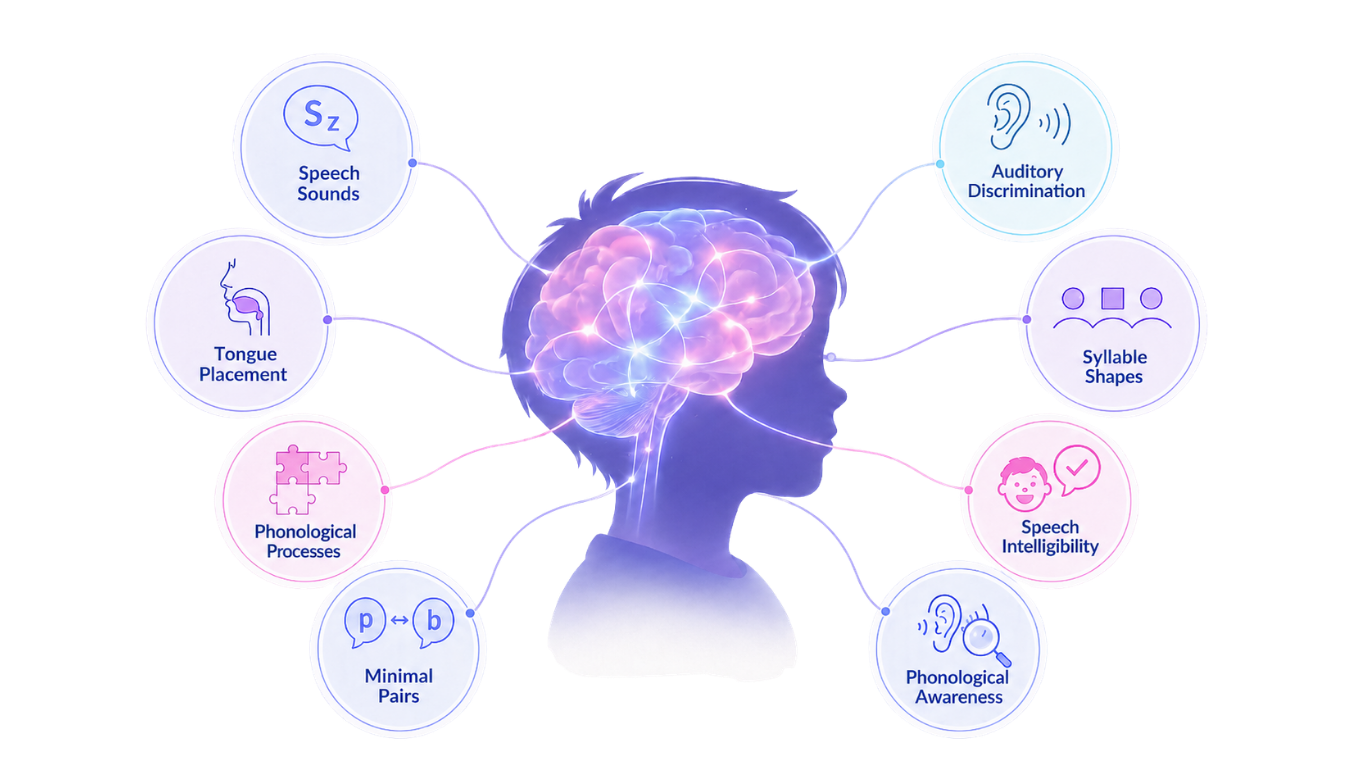
Effective therapy incorporates principles of motor learning and phonological development, including sufficient practice intensity, systematic feedback, and opportunities for generalization. The goal is not only accurate production in structured tasks but also consistent use of intelligible speech in spontaneous communication across different environments.

Speech Sound Assessment

What Happens During an Articulation and Phonology Assessment?

An articulation and phonology assessment is a comprehensive, evidence-based evaluation of a child’s speech sound system, including both phonetic production (articulation) and phonological organization (sound patterns).

Assessment usually includes both standardized and dynamic measures to support differential diagnosis and treatment planning. A comprehensive speech sound assessment may include:

parent or caregiver report of concerns, developmental history, and functional communication impact
teacher or caregiver input regarding intelligibility and participation at home or school
detailed case history, including medical, developmental, and hearing history
hearing screening or referral to audiology to rule out hearing issues as a contributing factor
oral mechanism examination assessing structure and function of the lips, tongue, jaw, palate, and dentition
standardized single-word articulation or phonology testing when appropriate
connected speech sample analysis to evaluate speech in naturalistic contexts
phonetic inventory analysis (consonants and vowels present in the child’s system)
analysis of speech sound errors by word position (initial, medial, final)
classification of error types (substitutions, omissions, distortions, additions)
phonological process analysis, including identification of typical and atypical patterns
assessment of syllable structure and word shape complexity
stimulability testing to determine whether the child can produce target sounds with cues
intelligibility ratings with familiar and unfamiliar listeners, often using percentage estimates or standardized scales
differential diagnosis to distinguish between articulation disorder, phonological disorder, childhood apraxia of speech, dysarthria, or speech differences related to dialect or multilingual development

Speech-language pathologists analyze assessment data to answer key diagnostic questions: Which phonemes are absent or in error? Are errors phonetic, phonological, or mixed? Do errors follow predictable patterns? Are patterns developmentally appropriate or atypical? Is the child stimulable for target sounds? What is the severity of the disorder based on intelligibility and error frequency? How does the speech sound profile impact functional communication?

A comprehensive speech sound evaluation integrates multiple data sources, including standardized scores, speech sample analysis, error patterns, intelligibility, stimulability, and functional impact.

Articulation and Phonology Goals

Articulation and Phonology Goals for Speech Therapy and IEPs

Articulation and phonology goals should be specific, measurable, functional, and based on the child’s speech sound evaluation. Strong goals should target the sounds, patterns, word positions, contexts, and communication situations that matter for the child’s intelligibility and participation.

A SMART speech sound goal should describe:

time reference
specific skill being targeted
context or activity
level of support
measurable outcome
how progress is measured
Phonological Processes and Articulation Areas
SMART Goal Example
Initial Consonant Deletion Goal
By the next IEP, given visual and verbal placement cues, the student will produce /k/ in the initial position of words with 80% accuracy across three consecutive sessions, as measured by SLP data collection.
Final Consonant Deletion Goal
By the next IEP period, during structured activities, the child will produce final consonants in CVC words with 80% accuracy, given minimal verbal prompts, across three consecutive sessions, as measured by SLP data collection.
Fronting Phonological Process Goal
By the next IEP, given minimal-pair contrasting /t/ and /k/ sounds, the student will reduce fronting by producing velar sounds /k/ and /g/ in target words with 80% accuracy across three consecutive sessions, as measured by SLP data collection.
Stopping Goal
By the next IEP, given structured speech activities, the student will produce fricatives /f/, /v/, /s/, or /z/ in word initial position of simple words, with 80% accuracy, given no more than 2 verbal prompts, as measured by SLP data collection.
Cluster Reduction Goal
By the next review period, during structured tasks, the student will produce two-element consonant clusters in target words (e.g., "spoon" instead of "poon") with 80% accuracy, given moderate verbal prompts, as measured by SLP data collection.
/S/ Sound Articulation Goal
By the next IEP, given visual feedback and placement cues, the student will produce /s/ in words and short phrases with 80% accuracy across three consecutive sessions, as measured by SLP data collection.
/R/ Sound Self-Monitoring and Carryover Goal
By the next IEP, during reading tasks and structured conversation, the student will produce vocalic /r/ sound and self-correct with 80% accuracy, given no more than one cue, as measured by SLP data collection.
Self-Monitoring Goal
By the next IEP, during classroom-based speaking tasks or conversation, the student will identify and correct target sound errors in 4 out of 5 opportunities, given minimal verbal cues.
Articulation and Phonology Activities

Articulation and Phonology Activities for Children

Articulation and phonology activities should match the child’s speech sound profile and therapy goals:

Articulation Activities for Toddlers

Try activities such as:

sound play with animal noises
copying early sounds during play
naming favorite toys that start with the same sound
using simple repetitive words
reading books with repeated sounds
modeling and exaggerating speech sounds during play
slowing down the rate of speech

For example: during play with cars, model words such as “go,” “car,” “beep,” “up,” and “more.” If the child attempts saying the word, praise and reinforce.

Articulation and Phonology Activities for Preschoolers

Try activities such as:

picture naming with target sounds
minimal pair games
sound-loaded books
sorting words by beginning or ending sound
play-based word repetition
silly sound games
short home practice routines

For example: if a child is working on initial consonants, you can use play routines with words such as “cup” vs "up"; “cat” vs "at"; “bus” vs "us". Model and practice phrases such as "the cup goes up", "the cat is at home", "the bus takes us to school" to let the child distinguish between the word pairs.  

Articulation and Phonology Activities for School-Age Children

Try activities such as:

target sound word lists
sentence practice
reading passages with target sounds
minimal pair contrast activities
phonological awareness games
sound sorting
conversation carryover tasks

For example: If a student is working on /s/, practice /s/ words in sentences, then in a short reading passage, then in a structured conversation on a preferred topic.

Articulation and Phonology Activities for Older Students

Try activities such as:

self-monitoring during conversation
recording and reviewing speech samples
practicing sounds during presentations
target sound practice in academic vocabulary
interview role-play
speech carryover during debate or discussion
practicing repair strategies when misunderstood

For example: if an older student is working on /r/, choose high-frequency words from their academics, hobbies, or daily life. Practice those words in sentences, then in short passages, presentations, or conversation.

Data Collection

Data Collection for Communication and Language Goals

SLPs often need to document not only whether a student performed a skill, but how much support was needed, how consistently the skill occurred, and whether the skill generalized across people, materials, or settings.

Accuracy and trials
Prompt level and cueing type
Level of independence
Frequency, duration, and rubric scores
Spontaneous use and generalization
See Data Collection Tools
Documentation

Documentation Examples for SLPs

Accurate documentation helps SLPs summarize what was targeted, how the student performed, what supports were needed, and how therapy connects to functional communication.

SOAP notes and session notes
Caregiver updates
IEP goal documentation
Evaluation summaries
Progress reports and present levels
Workflow

From Goal Writing to Progress Reports

Receptive language therapy is not one isolated session, it requires strcutured and individualized approach. iSpeax is designed to support  complete workflow from goal setting to intervention, data, collection, documentation management, finance, scheduling and more.

1
Choose communication skill
2
Write measurable goals
3
Plan therapy activities
4
Collect session data
5
Document progress
6
Generate reports
Articulation and Phonology FAQ

Frequently Asked Questions

What is articulation?

Articulation is how a child physically produces speech sounds. It involves appropriate placement of lips, tongue, teeth, jaw, and coordination of airflow for proper production of speech sounds.

What is phonology?

Phonology is how children learn and use the sound patterns of a language. It includes how sounds contrast with each other and how sounds are organized in words.

What is a speech sound disorder?

A speech sound disorder is an umbrella term for persistent difficulty producing speech sounds. It may include articulation difficulties, phonological difficulties, or both.

What is the difference between articulation disorder and phonological disorder?

An articulation disorder usually affects the production of specific sounds. A phonological disorder affects sound patterns or sound contrasts across groups of words.

Are phonological processes always a problem?

No. Some phonological processes are part of typical speech development in younger children. They become more concerning when they persist longer than expected, occur frequently, are atypical, or make the child difficult to understand.

What are most common phonological processes?

Most common phonological processes may include final consonant deletion, fronting, stopping, cluster reduction, weak syllable deletion, and gliding.

What are atypical phonological processes?

Some phonological processes are considered atypical because they are not commonly seen in typical speech development or may signal a more severe speech sound disorder. Examples of atypical phonological processes may include: backing (replacing front sounds like /t/ or /d/ with back sounds like /k/ or /g/); initial consonant deletion (leaving off the beginning sound of words, such as “at” for “cat”); glottal replacement (using a glottal stop instead of a consonant, such as “buh-er” for “butter”); vowel distortions or unusual vowel substitutions.

What are speech sound milestones?

Speech sound milestones is a general progression of speech sound development.

When should I worry about my child's speech?

Concern is appropriate when a child is very difficult to understand, has persistent sound errors, uses many speech sound patterns, becomes frustrated when speaking, avoids communication, or has speech differences that affect school or social participation.

Can speech therapy help with articulation and phonology?

Yes. Many children improve with individualized, evidence-informed speech therapy. Treatment may target sound placement, sound production, phonological patterns, intelligibility, self-monitoring, and carryover into conversation.

Should I correct my child every time they say a sound wrong?

Usually no. Constant correction can increase frustration. It is better to follow the SLP’s plan, model the word, practice briefly and consistently, and keep everyday communication positive.

Do articulation and phonology difficulties affect reading and writing?

They can, especially when speech sound difficulties occur with broader language or phonological awareness weaknesses. Not every child with speech sound errors has reading or writing difficulty, but some children may benefit from monitoring of early literacy and sound awareness skills.

Can older students still work on speech sounds?

Yes. Older children and teens can still benefit from speech therapy for residual sound errors, especially when speech affects presentations, classroom participation, interviews, or social communication.

Support Articulation and Phonology with iSpeax

iSpeax helps speech-language pathologists, educators, and therapy teams organize speech sound support, track articulation and phonology progress, and manage documentation in one connected workflow.

From speech sound production, sound placement, and intelligibility to phonological processes, word shapes, carryover, self-monitoring, and classroom participation, iSpeax helps providers connect intervention planning to measurable data and streamlined documentation.

Whether you are supporting students with articulation goals, phonological patterns, residual speech sound errors, or speech clarity in conversation, iSpeax helps turn therapy data into organized notes, progress updates, caregiver-friendly summaries, and compliant reports.