SLP Goal Bank

SMART Speech Therapy Goals

What Are SMART Goals?

S.M.A.R.T. Speech Therapy Goals

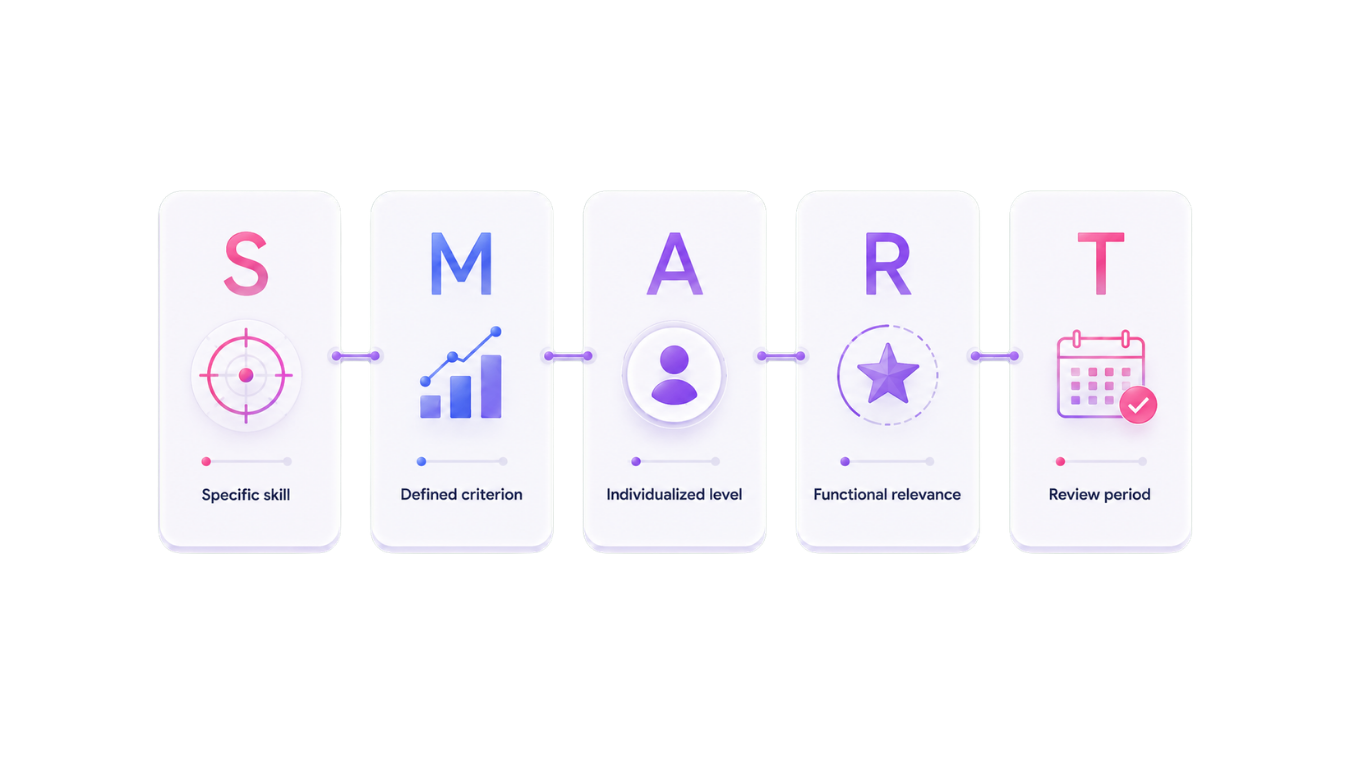
SMART Speech and language goals are designed to facilitate the development of communication skills that support academic achievement, social participation, interpersonal relationships, functional independence, and activities of daily living. Effective goals are specific, measurable, functionally relevant, time-bound and aligned with the individual’s communication profile as determined through comprehensive assessment. This goal bank provides evidence-informed examples across domains including receptive language, expressive language, pragmatic language, augmentative and alternative communication (AAC) and functional communication, early language development, articulation, and phonology.

SMART Goal Formula

How to write SMART Speech Therapy Goals?

In speech therapy and IEP documentation, a strong goal usually includes:

time frame
communication area being targeted
specific skill
activity or context
level of support
target outcome such as accuracy
how progress will be measured
whether the skill should generalize (optional)

A simple formula for speech and language goals is:

By [time frame], given [context/activity/support], the student will [target communication skill] with [measurable accuracy/frequency/independence], across [number of sessions/settings/opportunities], as measured by [data source].

SMART speech therapy goal example:

By the next IEP review, given short stories or pictures, the student will answer who, what, where, and when questions using complete sentences, with 80% accuracy, across three consecutive sessions, as measured by SLP data collection.

Receptive Language Goal Bank

Receptive Language Goals for Speech Therapy and IEPs

Receptive language goals target how a child understands language. They may focus on following directions, understanding vocabulary, answering questions, identifying concepts, understanding stories, processing classroom instructions, or interpreting spoken and written information.

Receptive Language Area
SMART Goal Example
Following Directions Goal
By the next IEP, given a classroom-based activity, the student will follow two-step directions containing temporal or spacial concepts, such as before, after, first, last, in, on, and under, with 80% accuracy, given minimal verbal prompts, across three consecutive sessions, as measured by SLP data collection.
WH-Question Goal
By the next IEP, given a short story or reading passage, the student will answer who, what, where, and when questions with 80% accuracy, given visual supports as needed, across three consecutive sessions, as measured by SLP data collection.
Vocabulary Goal
By the next IEP, given grade-level vocabulary activities, the student will identify the meaning of target Tier 2 words using context clues, synonyms or antonyms, with 80% accuracy, given no more that 2 prompts, across three consecutive sessions, as measured by SLP data collection.
Spatial, Temporal or Descriptive Concept Goal
By the next IEP, given structured language activities, the student will demonstrate understanding of spatial, temporal, and descriptive concepts by selecting, pointing to, or following  simple directions with 80% accuracy, given minimal verbal support, across three sessions, as measured by SLP data collection.
Listening Comprehension Goal
By the next IEP, given a short spoken passage, the student will identify key details, sequence events, and answer comprehension questions in 80% of opportunities, given moderate verbal prompts, across three sessions, as measured by SLP data collection.
Inferencing and Higher-Level Language Goal
By the next IEP, given a short academic or informational passage, the student will identify the main idea and make an inference using at least one relevant detail from the text, in 4 out of 5 trials, given minimal prompts, across three consecutive sessions, as measured by SLP data collection.
Expressive Language Goal Bank

Expressive Language Goals for Speech Therapy and IEPs

Expressive language goals target how a child communicates thoughts, needs, feelings, ideas, and information. They may focus on vocabulary, word retrieval, sentence formulation, grammar, answering questions, storytelling, explaining ideas, or participating in classroom discussion.

Expressive Language Area
SMART Goal Example
Vocabulary Goal
By the next IEP, given grade-level vocabulary activities, the student will use target Tier 2 words when formulating sentences, with 80% accuracy, given no more than 2 prompts, across three consecutive sessions, as measured by SLP data collection.
Formulating Sentences Goal
By the next IEP, given a picture, event, or classroom topic, the student will produce a complete sentence containing a subject, verb, and object, with 80% accuracy, given minimal verbal prompts, across three consecutive sessions, as measured by SLP data collection.
Grammar Goal
By the next IEP, given structured language activities, the student will use regular and irregular past tense verbs in spoken sentences with 80% accuracy, given minimal verbal prompts, across three consecutive sessions, as measured by SLP data collection.
WH-Questions Goal
By the next IEP, given a short story, picture scene, or language activity, the student will answer who, what, where, when, and why questions using complete sentences, with 80% accuracy, given minimal cues, across three consecutive sessions, as measured by SLP data collection.
Narrative Language Goal
By the next IEP, given a short story and a graphic organizer, the student will retell the story by providing characters, setting, problem, at least three events, and an ending in 4 out of 5 trials, across three  sessions, as measured by SLP data collection.
Word Retrieval Goal
By the next IEP, during structured naming tasks, the student will use word-retrieval strategies such as describing function, category, or attributes to describe the target word in 80% of trialed opportunities, with minimal prompts, as measured by SLP data collection.
Conversation Goal
By the next IEP, during structured conversation activities, the student will make a relevant comment or ask a related question for at least three conversational turns in 4 out of 5 trials, given no more than 2 verbal prompts, as measured by SLP data collection.
Pragmatic Language Goal Bank

Pragmatic Language Goals for Speech Therapy and IEPs

Pragmatic language goals target how a child uses communication socially. They may focus on conversation, social interaction, topic maintenance, turn-taking, perspective-taking, nonverbal communication, inferencing, social problem-solving, repair strategies, and self-advocacy.

Pragmatic Language Area
SMART Goal Example
Conversation Initiation Goal
By the next IEP, during structured peer or adult interaction, the student will initiate a conversation using an appropriate greeting, comment, or question in 4 out of 5 opportunities, given visual or verbal support as needed, across three consecutive sessions, as measured by SLP data collection.
Turn-Taking Goal
By the next IEP, during a structured game or conversation activity, the student will take at least three reciprocal turns with a communication partner in 4 out of 5 opportunities, given minimal verbal prompts, as measured by SLP data collection.
Topic Maintenance Goal
By the next IEP, during a structured conversation, the student will make a relevant comment or ask a related question to maintain the topic of discussion for at least three conversational turns in 4 out of 5 trials, given minimal support, as measured by SLP data collection.
Conversational Repair Goal
By the next IEP, when a communication breakdown occurs, the student will use a repair strategy, such as repeating, rephrasing, adding detail, or asking for clarification, in 4 out of 5 opportunities, given minimal verbal prompts, as measured by SLP data collection.
Perspective-Taking Goal
By the next IEP, given a social scenario, the student will accurately identify another person’s thought, feeling, or perspective and explain one reason behind it, in 4 out of 5 trials, given minimal verbal support, as measured by SLP data collection.
Inferencing Goal
By the next IEP, after listening to or reading a short passage, the student will explain implied meaning or character intent using at least one relevant clue from the text with 80% accuracy, given minimal prompts, as measured by SLP data collection.
Nonliteral Language Goal
By the next IEP, given grade-level idioms, jokes, sarcasm, or figurative expressions, the student will explain the intended meaning with 80% accuracy, given minimal cues, as measured by SLP data collection.
AAC Goal Bank

AAC and Functional Communication Goals

AAC goals support functional communication by helping a child use reliable communication methods to support speech and language expression. AAC may include gestures, signs, pictures, communication boards, speech-generating devices, writing, or a combination of methods.

AAC Area of Need
SMART Goal Example
Requesting AAC Goal
By the next review period, during meals, play, or classroom routines, the child will request a preferred item or activity using speech, sign, picture, gesture, or AAC picture board, in 4 out of 5 opportunities, given modeling as needed.
Rejecting and Protesting AAC Goal
By the next review period, during daily routines, the child will make a functional message such as “no,” “stop,” “all done,” or “not that” using speech, sign, picture, or AAC board, in 4 out of 5 opportunities.
Choice-Making AAC Goal
By the next review period, given two or more options, the child will make a choice using eye gaze, pointing, gesture, picture selection, or AAC board, in 4 out of 5 opportunities across three routines.
Requesting Help AAC Goal
By the next IEP, during classroom or therapy tasks, the student will request help using speech, a visual support, or AAC system in 4 out of 5 opportunities, given no more than one prompt.
Making Comments AAC Goal
By the next IEP, during play, book reading, or classroom activities, the student will make a comment using speech, sign, picture symbols, or AAC in 4 out of 5 opportunities, given aided language modeling.
Core Vocabulary AAC Goal
By the next IEP, during structured tasks and routines, the student will use target core vocabulary words (e.g., go, stop, more, help, want, like) on their AAC device, across three different activities with 80% accuracy.
Operational AAC Goal
By the next IEP, given access to their AAC system, the student will navigate to a familiar vocabulary page or symbol category to communicate a functional message in 4 out of 5 opportunities, given minimal support.
Articulation and Phonology Goal Bank

Articulation and Phonology Goals for Speech Therapy and IEPs

Articulation and phonology goals target speech sound development and intelligibility. Articulation goals usually focus on how a child physically produces specific speech sounds. Phonology goals usually focus on sound patterns that affect groups of sounds or word shapes.

Phonological Processes and Articulation Areas
SMART Goal Example
Initial Consonant Deletion Goal
By the next IEP, given visual and verbal placement cues, the student will produce /k/ in the initial position of words with 80% accuracy across three consecutive sessions, as measured by SLP data collection.
Final Consonant Deletion Goal
By the next IEP period, during structured activities, the child will produce final consonants in CVC words with 80% accuracy, given minimal verbal prompts, across three consecutive sessions, as measured by SLP data collection.
Fronting Phonological Process Goal
By the next IEP, given minimal-pair contrasting /t/ and /k/ sounds, the student will reduce fronting by producing velar sounds /k/ and /g/ in target words with 80% accuracy across three consecutive sessions, as measured by SLP data collection.
Stopping Goal
By the next IEP, given structured speech activities, the student will produce fricatives /f/, /v/, /s/, or /z/ in word initial position of simple words, with 80% accuracy, given no more than 2 verbal prompts, as measured by SLP data collection.
Cluster Reduction Goal
By the next review period, during structured tasks, the student will produce two-element consonant clusters in target words (e.g., "spoon" instead of "poon") with 80% accuracy, given moderate verbal prompts, as measured by SLP data collection.
/S/ Sound Articulation Goal
By the next IEP, given visual feedback and placement cues, the student will produce /s/ in words and short phrases with 80% accuracy across three consecutive sessions, as measured by SLP data collection.
/R/ Sound Self-Monitoring and Carryover Goal
By the next IEP, during reading tasks and structured conversation, the student will produce vocalic /r/ sound and self-correct with 80% accuracy, given no more than one cue, as measured by SLP data collection.
Self-Monitoring Goal
By the next IEP, during classroom-based speaking tasks or conversation, the student will identify and correct target sound errors in 4 out of 5 opportunities, given minimal verbal cues.
Early Language Goal Bank

Early Language Goals for Speech Therapy and Early Intervention

Early language goals target the foundational communication skills that develop in the early years. They may focus on shared attention, gestures, imitation, vocal play, babbling, first words, word combinations, play skills, following directions, and requesting during daily routines.

Early Language Area
SMART Goal Example
Joint Attention Goal
By the next IFSP period, during play or book reading, the child will shift attention between an object and adult by looking, pointing, showing, or vocalizing in 4 out of 5 opportunities, given fading cues.
Gesture Goal
By the next IFSP period, during daily routines, the child will use a gesture such as pointing, touching, waving, or signing (e.g., "more"), to request, greet or identify, in 4 out of 5 opportunities, given moderate visual cues.
Functional Communication Goal
By the next IFSP period, during meals, play, or routines, the child will communicate a request, protest, or comment using a word, sign, gesture, or vocalization in 4 out of 5 opportunities.
First Words Goal
By the next IFSP period, during preferred routines, the child will use at least 10 functional words, signs, or word approximations to request, label, greet, or comment across three different routines.
Combining Words Goal
By the next IFSP period, during play and daily routines, the child will make two-word utterances, such as “more bubbles,” “mommy up,” or “go car,” in 4 out of 5 opportunities, given models and prompts.
Receptive Language Goal
By the next IFSP period, given a familiar routine, the child will follow one-step directions such as “give me,” “put in,” or “get shoes” in 4 out of 5 opportunities, given gestures or visual support as needed.
Imitation Goal
By the next IFSP period, during play, songs, or routines, the child will imitate an action, sound, word, or gesture in 4 out of 5 opportunities, given adult modeling.
Pretend Play Goal
By the next review period, during play routines, the child will engage in pretend play, and imitate actions such as feeding a doll or making a toy animal sleep, in 4 out of 5 opportunities, given modeling as needed
Sentence Expansion Goal
By the next IFSP period, during conversation and routines, the child will produce three- to four-word phrases to comment, request, or describe in 4 out of 5 opportunities, given minimal verbal prompts.
Data Collection

Data Collection for Communication and Language Goals

SLPs often need to document not only whether a student performed a skill, but how much support was needed, how consistently the skill occurred, and whether the skill generalized across people, materials, or settings.

Accuracy and trials
Prompt level and cueing type
Level of independence
Frequency, duration, and rubric scores
Spontaneous use and generalization
See Data Collection Tools
Documentation

Documentation Examples for SLPs

Accurate documentation helps SLPs summarize what was targeted, how the student performed, what supports were needed, and how therapy connects to functional communication.

SOAP notes and session notes
Caregiver updates
IEP goal documentation
Evaluation summaries
Progress reports and present levels
Workflow

From Goal Writing to Progress Reports

Receptive language therapy is not one isolated session, it requires strcutured and individualized approach. iSpeax is designed to support  complete workflow from goal setting to intervention, data, collection, documentation management, finance, scheduling and more.

1
Choose communication skill
2
Write measurable goals
3
Plan therapy activities
4
Collect session data
5
Document progress
6
Generate reports

Build SMART Speech and Language Goals with iSpeax

iSpeax helps speech-language pathologists, educators, and therapy teams create, organize, and track communication goals in one connected workflow.

From receptive language and expressive language goals to pragmatic language, AAC, early language, articulation, and phonology, iSpeax helps turn goal writing, session data, and progress documentation into a streamlined, compliant process.

Whether you are writing IEP goals, tracking therapy progress, or preparing reports, iSpeax helps connect each student’s goals to real data, tailored intervention, and organized documentation.